









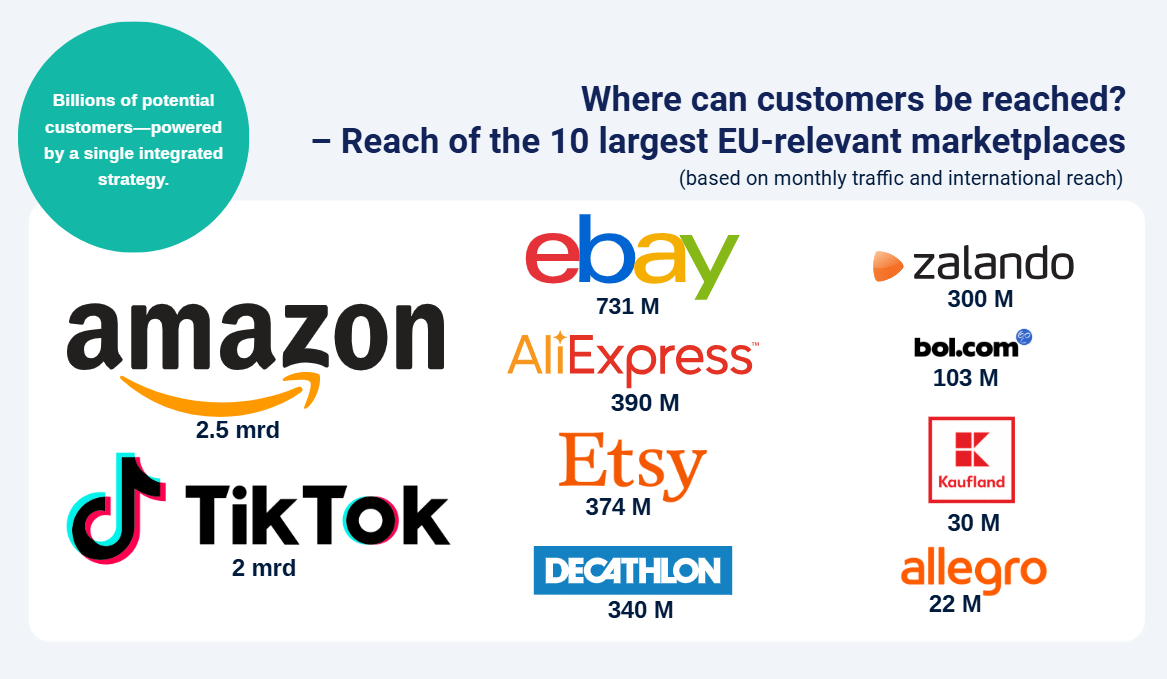
At the same time, the Central and Eastern European region is only now entering this phase. In Hungary, the Czech Republic, and Slovakia, marketplace share is still significantly lower, representing both a lag and substantial growth potential. In the case of marketplace expansion, the question is no longer whether to enter, but how to do so in a controlled, profitable, and sustainably scalable way.
Marketplaces Are Not Channels, but Operating Models
Many merchants still view marketplaces as “additional sales channels,” but in reality, they represent a complete shift in operating model. Multiple countries, multiple marketplaces, different pricing strategies, inventory logic, and delivery promises all appear simultaneously. Without a unified framework, this complexity quickly becomes unmanageable.
The Five Control Points of Marketplace Success
Scalable marketplace operations are built on five key pillars:
Product Data
High-quality listings are not optional. Without correct categories, complete attribute sets, localized titles and descriptions, proper imagery, and identifiers, conversion rates are compromised from the very first step.
Accurate and Up-to-Date Inventory
Marketplace ranking algorithms reward accurate inventory data. Real-time or near real-time synchronization is not a technical luxury, but a business necessity.
Competitive but Controlled Pricing
Pricing is not based on intuition. Commissions, shipping costs, returns, marketing, and operations together determine actual profitability. Without automated rules, growth can quickly turn into losses.
Fulfillment Experience and Promise Management
On a marketplace, there are two customers: the buyer and the marketplace itself. Delivery times, status communication, and warranty handling directly impact visibility and buy box positioning.
Automated Operations
There is no scaling without automation. Without automating products, pricing, inventory, orders, invoicing, and communication, an explosion in complexity is inevitable.

Why a Marketplace Engine Alone Is Not Enough
Systems that provide technical access to marketplaces—so-called marketplace engines—are necessary, but not sufficient for successful expansion. They handle listing, order intake, and basic synchronization, but they do not align business operations.
The real challenge begins when multiple channels, countries, and business models must be managed simultaneously: webshop, marketplace, B2B, retail, fulfillment partners, and internal systems all need to work together in a coordinated way.
Unified Promises – The Real Value Proposition
Customers do not choose channels—they choose promises: what they get, at what price, and when. Today, these promises are made not only in webshops, but simultaneously across marketplaces, B2B portals, retail environments, and multiple countries.
The most common reason for omnichannel failure is not technological, but operational: promises become fragmented.
The true value proposition of unified commerce operations is that the same business truth applies across all channels—in terms of inventory, pricing, delivery times, status, and fulfillment logic. This is not a matter of post-hoc alignment, but a system-level capability.
How Base and kotta Complement Each Other
Marketplace expansion requires two things: fast and stable marketplace presence, and the ability to maintain consistent promises across all channels while scaling.
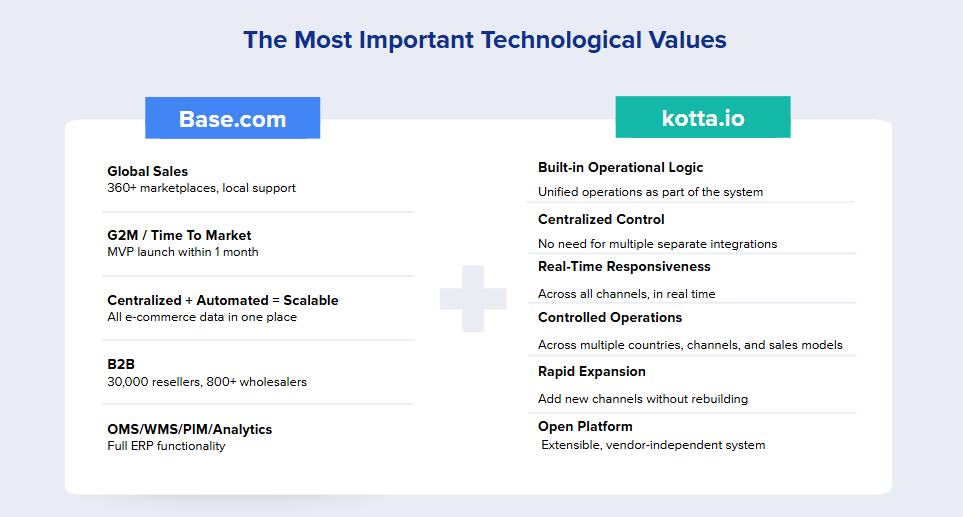
Base supports the first step. It provides the technical foundation for marketplace operations, enabling merchants to operate across multiple marketplaces and countries simultaneously, while managing product data, pricing, inventory, and orders in a unified way. Base ensures fast market entry and stable, scalable operations.
kotta.io builds on this foundation. It ensures that marketplaces, webshops, B2B sales, retail channels, and fulfillment partners do not operate with separate logic. kotta aligns pricing, inventory, delivery times, and service rules, ensuring that the same “business truth” applies across all channels.
What Does This Mean in Practice?
Together, Base and kotta enable more transparent and manageable growth:
- fast entry into multiple marketplaces and countries,
- consistent and reliable promises across all sales channels,
- manageable complexity even as volume grows,
- scalable operations that do not rely on manual exceptions or ad hoc decisions.
The real limit to scaling is not how many marketplaces you can technically connect to, but whether you can consistently deliver the same promise everywhere. Base provides the stable foundation for marketplace presence, while kotta ensures that this operation remains commercially sustainable in the long term.
Controlled Growth Instead of Exploding Complexity
Marketplaces offer enormous growth potential—but only for those who approach operations at a systems level. Without standardized processes, automation, a unified data model, and clearly defined responsibilities, rapid expansion becomes a business risk.
The goal is not to be present on as many marketplaces as possible, but to ensure that presence is profitable, sustainable, and scalable.
Real value is created where technology, operations, and business thinking converge.